Home Use Cases Pharma · Supply Chain Engineering
Pharma & Life Sciences

The right medicine in the right place —
on the way to the right patient.

Choosing locations, assigning customers, placing products — in an industry where cold chain, regulatory approval and lead time are non-negotiable. W2MO Supply Chain Engineering puts these decisions on a data-driven foundation.

6–12 week projects CSV or SAP connector 15+ years
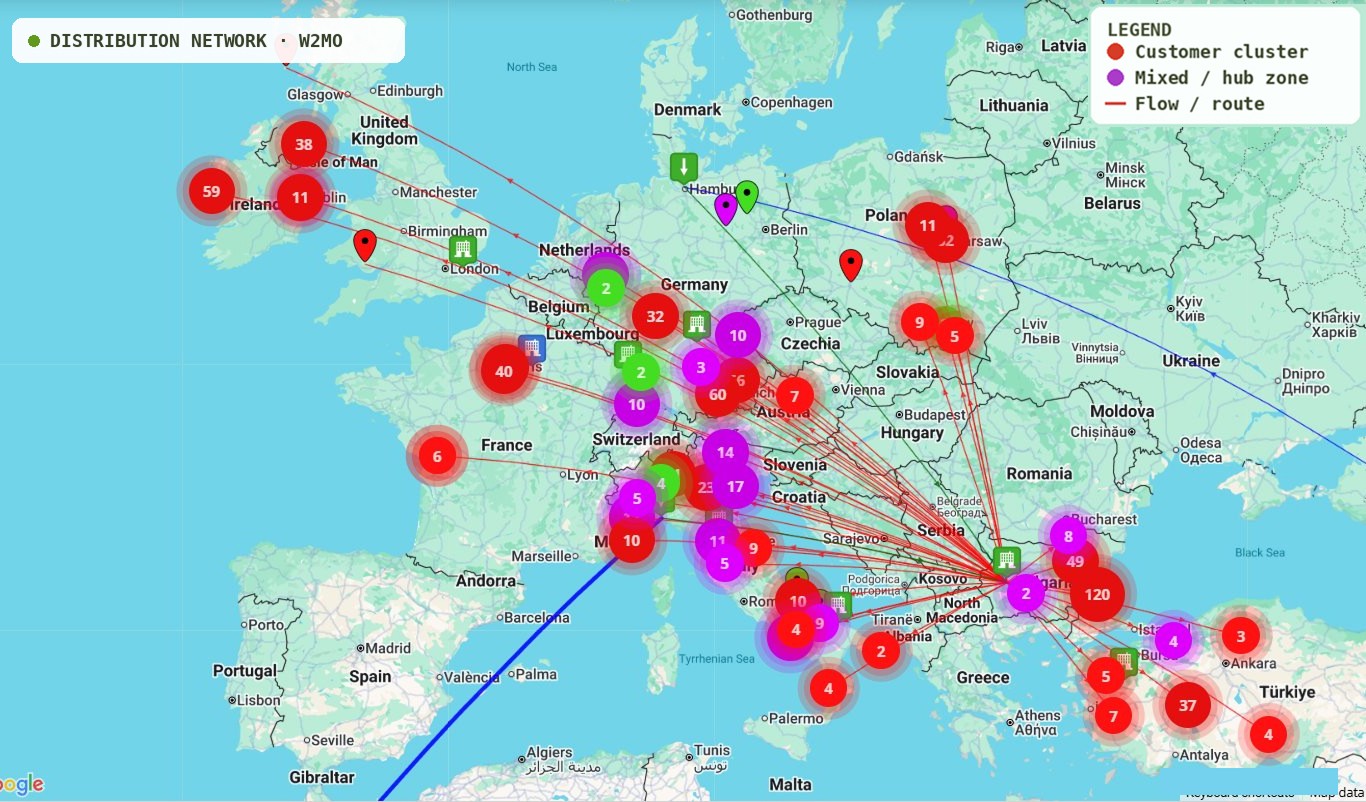
Network scenario · W2MO 3 of 8 HUB NORTH HUB EAST HUB SOUTH
Logistics cost
up to
15%

Total network cost through optimised site choice and assignment.

Service level
up to
+20%

more customers reachable within the committed 24h/48h window.

Planning confidence
with scenarios
not gut feel

Data-driven decisions with comparable, side-by-side scenarios.

Sound familiar?

Sentences we hear again and again in pharma networks.

Five typical situations from day-to-day management — you will recognise at least one of them.

After the last acquisition we now have three warehouses doing the same thing

M&A consolidation without a systematic network analysis: sites were inherited, not strategically chosen. Which one stays, which one goes, who gets which products — the question is there, the answer is not.

The cold chain doesn't allow quick fixes

One product 2–8 °C, another below −20 °C, a third at room temperature — and on top of that, marketing authorisations that only allow certain goods from certain locations. Every reshuffle becomes a regulatory project.

We need another distribution centre — but where?

Growth in a market accelerates, existing sites are bursting at the seams, transport costs are climbing. A new location is overdue — but the decision rests on two slides and an Excel sheet.

Our customer assignment grew historically, it was never planned

Pharmacy wholesalers are supplied from the warehouse they have „always" been supplied from — not from the one that is closest today, or the cheapest.

The next crisis will come — and we don't know how robust we are

Pandemics, geopolitical tensions, tariff changes: every supply chain that looks stable today can become a bottleneck tomorrow. Without scenario modelling, resilience stays a claim.

The core of this use case

Two assignments that decide cost and service.

Once the sites are set, the actual work happens in the assignments — and in pharma those assignments carry regulatory, medical and commercial consequences.

Assignment 1

Customers to sites

Which customer is served from which warehouse? That decision drives transport cost, lead time and service level — and depends on more than just distance.

  • Transport cost and time per relation
  • Service-level commitments (e.g. 24h direct delivery to hospital pharmacies)
  • Customer clusters with shared requirements
  • Regional specifics like toll roads or customs borders
  • Load distribution across sites
Assignment 2

Products to sites

Which product is stocked at which site? In pharma this carries more weight than elsewhere — authorisations, temperature zones and serialisation obligations all weigh in.

  • Regulatory approvals per market and site
  • Temperature zones (2–8 °C, −20 °C, room temperature)
  • Turnover frequency and demand patterns
  • Critical SKUs with redundant storage
  • Serialisation and track-and-trace requirements
Typical objectives

What supply chain leaders in pharma talk to us about.

Six topics that come up in almost every first conversation — usually several in parallel.

  • Re-architect the network strategically — after M&A, market growth, near-shoring
  • Optimise customer-to-site assignment for cost and service level
  • Optimise product-to-site assignment under regulatory and cold-chain constraints
  • Identify additional sites — centre-of-gravity plus location-candidate grid
  • Compare several scenarios in parallel — cost, service, resilience, CO₂
  • Prepare the transition from network design into site design for selected sites
Our approach

From a digital twin of the network to a well-founded decision.

Four steps that have proven themselves in comparable projects. Typical project duration: 6 to 12 weeks — depending on data availability and complexity.

01
Week 1–3

As-is model

Digital twin of your existing network: sites, customers, product flows, costs. Data usually from Excel or CSV exports — or via W2MO connectors directly from SAP and other systems if preferred.

02
Week 2–5

Ideal scenario

Mathematical optimisation with no constraints: what would the best solution be if nothing got in the way? Centre-of-gravity analysis and a location-candidate grid produce the theoretical cost optimum as a benchmark.

03
Week 4–9

Real-world scenarios

Adding constraints: capacities, regulatory approvals, cold-chain requirements. Up to four models in parallel in the scenario manager — consolidation, expansion, near-shoring, resilience.

04
Week 8–12

Result & roadmap

Consolidation, recommendation, implementation roadmap. A solid basis for the board decision — and, if wanted, a handover into a site-design model for the selected warehouses.

The result is not a one-off network decision, but a living model of your supply-chain network — updatable any time markets, portfolio or regulatory boundaries change.

Powered by AI

Generative AI makes scenarios easier to negotiate.

Network decisions involve many stakeholders — procurement, sales, regulatory, finance. With AI assistance, the model becomes a conversation partner instead of an expert tool.

Questions instead of reports

„What happens to transport cost if we close the Hannover site?" or „Which products would have to be stocked redundantly in two locations?" — answers directly from the digital twin.

MCP server as a bridge

The MCP architecture lets AI models access the network digital twin, scenario data and optimisation algorithms directly — no manual interface work.

Data integration

Pharma data is often spread across several systems — ERP, regulatory databases, cold-chain monitoring. AI-generated mappings accelerate consolidation and surface data gaps early.

Bring your own AI model

Connect any LLM — Claude, ChatGPT, Gemini or your own — through the W2MO MCP server. You choose the model, you control the data. No vendor lock-in.

What used to take weeks — modelling new scenarios, preparing KPIs, producing presentations — now runs in hours, through a conversation.
What is typically achievable

Ranges we regularly see.

Values from comparable pharma projects over recent years. The exact range depends on the size and structure of the network.

−10 to −15%

logistics cost across the network through optimised sites and assignments.

+15 to +20%

more customers reachable within the committed service-level window.

up to −20%

transport kilometres and the CO₂ emissions tied to them.

4models

compared in parallel in the scenario manager — cost, service, resilience, CO₂.

Worked example

European pharma distribution network with five sites

For an annual transport budget in the mid double-digit million range, even 10 % network optimisation potential translates into a single-digit million contribution per year — durably, not as a one-off. On top of that come effects that are harder to quantify but often more important: higher service reliability, lower compliance risk and stronger resilience against disruption.

The ranges above depend heavily on the size and structure of the existing network. A first assessment based on rough indicators is possible within a few days.

Trust

Logivations — trust grounded in numbers.

30,000+
Professional W2MO users
500+
Consulting projects
15+
Years of practice
Pharma Life Sciences Medical devices FMCG Retail Automotive Industrial goods
Frequently asked

What customers ask us before a project.

Five topics that come up in almost every preliminary conversation.

We don't have a clean data foundation — can we still start?

Yes. Experience shows that data gaps are the rule, not the exception. The W2MO smart-data logic detects gaps and inconsistencies systematically and proposes plausible corrections. Data is usually supplied via CSV exports — a direct connection to SAP or other systems is possible, but not a prerequisite. The project start does not depend on perfect data — only on knowing what we are computing with.

How are regulatory requirements (approvals, GDP) represented in the model?

Regulatory requirements are configured as constraints — which SKUs may be stored at which sites, which temperature class is required, which markets may be supplied from which site. The system itself has no opinion on the underlying regulations; maintaining those rules sits with you and your regulatory team. Once captured, the model only computes variants that respect them — non-compliant assignments are excluded automatically.

We have hundreds of millions of order lines — can the system even handle that?

Yes. W2MO's non-relational data structure and parallelised algorithms are built for exactly this kind of volume. Networks with hundreds of millions of order lines and large customer bases are a standard case, not an edge case.

Can we evaluate several scenarios at once?

Yes — that is in fact the central idea. The scenario manager keeps up to four models in sync in parallel. Customers typically compare, for example, the status quo, a consolidation variant, an expansion variant and a resilience variant. Filters by product or customer groups allow additional regional or category-specific analyses.

How do network design and later site design relate to each other?

In the network model we define sites, volumes and requirements. For selected sites that data can be carried over into a site-design model — volumes, inbound and outbound flows and service requirements are available as a starting point. This is not automatic; it is a deliberate next project step that you initiate. The benefit: you work in one platform throughout — from the strategic network model to the operational warehouse layout.