Identification Workplace.
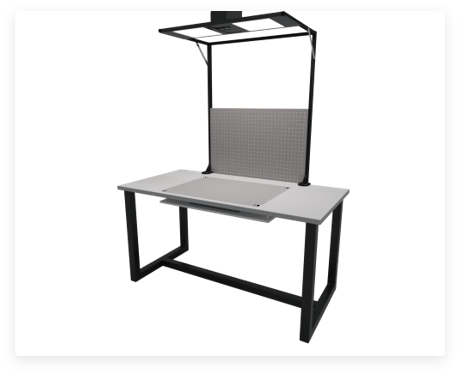
Cameras and AI speed up identification and verification work at a stationary workstation.
AI-Based Master Data Acquisition.
Capture complete, accurate master data in seconds — directly at an existing workstation.
- Measurement of weight and product dimensions
- Even irregularly shaped objects can be measured
- Automatic saving of product images
- Integrated barcode and QR code reading
- Optional integration of automatic counting and recognition
- Possibility of custom extensions for special setups
One of the biggest problems in logistics is missing master data. Virtually every company complains that information about product dimensions and weights is incomplete or incorrect. The cost of these deficiencies is enormous.
Gathering the missing master data with conventional 3D scanners is too time-consuming. Handling each product takes a long time. Manual measurement is not a solution either; it is also time intensive and error prone — the measurements may be incorrectly determined or entered into the system incorrectly.
Logivations AI-based master data collection is simple, fast and can be integrated into existing workstations. Product identification by scanning a code and the automatic capture of product images are included as standard.
AI-Based Product Identification.
Identify any product reliably — by dimensions, weight, codes, text or appearance.
- Identify products based on master data
- Interactive selection via product images
- Easy setup — with or without interface
- Integration into existing workstation
The master data acquisition setup can also be used for product identification. Simply place a product under the camera and compare it to your product database based on dimensions and weight. If several products match your item based on the selected accuracy, you can interactively select the right product by comparing it to existing product images.
In addition to code and text reading and classification of products by their size, we can use the appearance of products to identify them. We can either simply integrate ChatGPT for a basic and general product classification or we can train an AI for product differentiation purely based on your product data. By combining all these different identification options, we can uniquely identify every single product.
This use case can be integrated into an existing workstation and is a plug-and-play solution as it can run without a permanent interface.
AI Packstation.
Identify, pack and document shipments in one guided, AI-driven process.
- Identification and recognition of products with and without barcodes
- Calculation of a 3D packing scheme for optimal packing into any shipping carton
- Documentation of the packing process via video
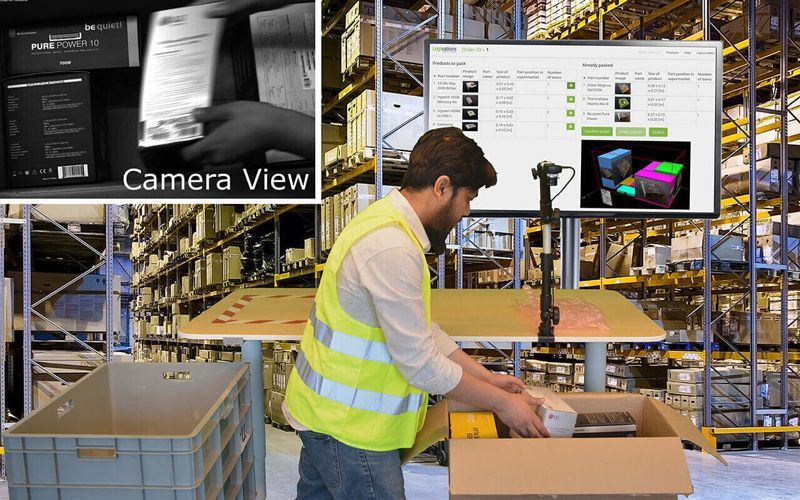
Packing shipments is often a time-consuming and labor-intensive process. Products need to be identified, properly packed into the box, and documentation may be required to prevent the customer from later disputing acceptance of some or all of the products shipped. All of this is now available in the W2MO AI Packstation!
Products can be identified by scanning a barcode, QR code or data matrix code. For products without such a code, recognition can be trained based on appearance.
The packaging itself can be guided using the W2MO Case Pack 3D view. It selects the correct carton type, calculates the packing scheme for the case and guides the user to pack the products in the correct order.
Documentation of the packing process is easy with the automatically created video of the packing process. The video files are stored and managed on the W2MO server, so there is no need to transfer large files to your system. Simply use a link with the order number to access the video.
Text Reading (OCR).
Read any text on a label and extract exactly the information you need.
- Read any type of text
- Find predefined keywords
- Match keyword content
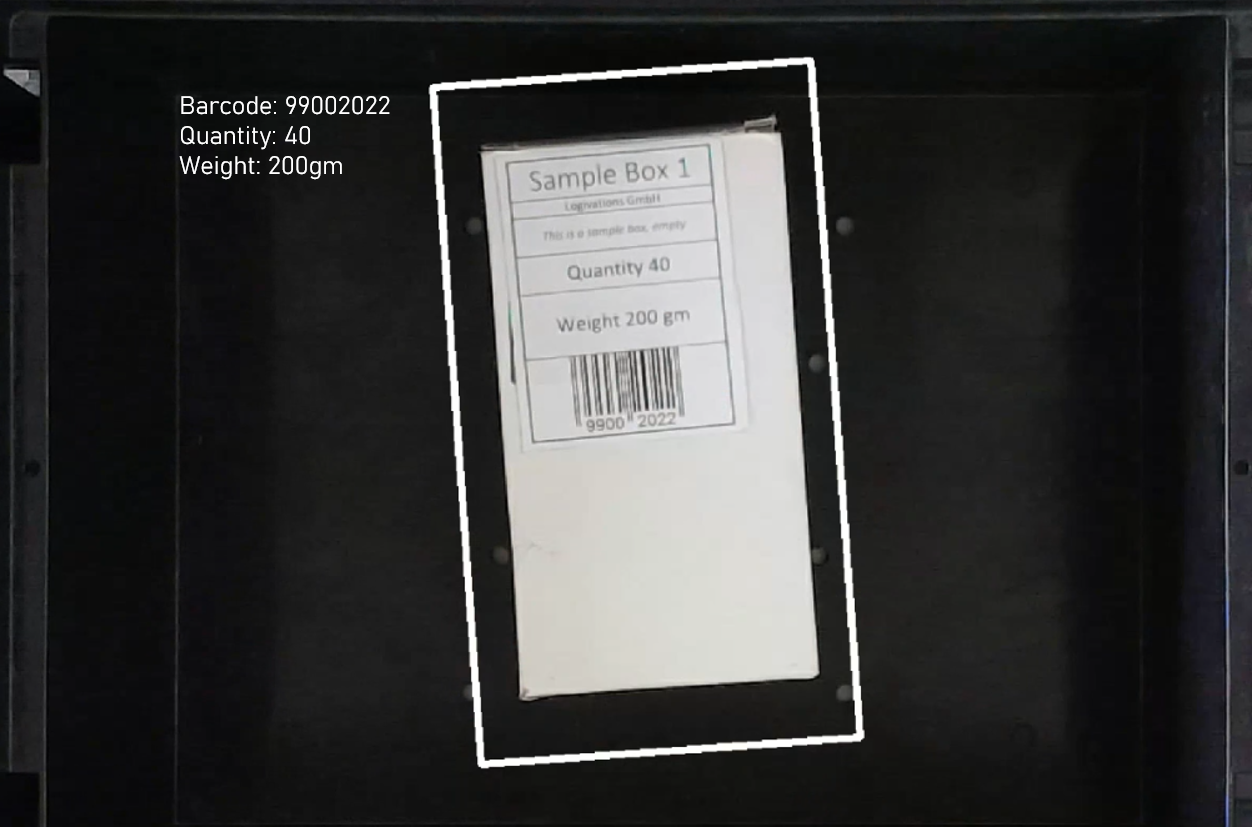
Need to extract some information from a label that is not encoded in a barcode? With W2MO OCR you can read all types of text and extract relevant information based on predefined keywords. For example, you can extract quantity or lot number information from a label and compare it to expected data. This reading can even be done while the package is moving on a conveyor.
AI-Based Counting.
Count all visible goods in milliseconds — fast, reliable and easy to integrate.
- Counting of all visible goods — special cases can be easily trained
- Extremely fast and reliable
- Validate read codes by checking them against the counting result
- Easy to integrate via USB interface or other integration technologies
- Documentation of the counting and recognition process with images
Counting is a common and time-consuming task in logistics. Most counting processes can be automated with W2MO. If the products do not touch or can be separated at the time of counting, this can be done without further training of the system. For special cases, the product or its type can be trained and then the system can count the learned and visible products in milliseconds. At the same time, QR codes or barcodes on the objects can be read and processed, layer packing schemes can be identified, or the number of codes read can be validated by the counting result.
Pick Tracking.
Track picking movements scanner-free and gain up to 35% in productivity.
- Scanner-free determination of pick movements
- Track arm movement during picking to prevent errors
- 20% – 35% productivity gain
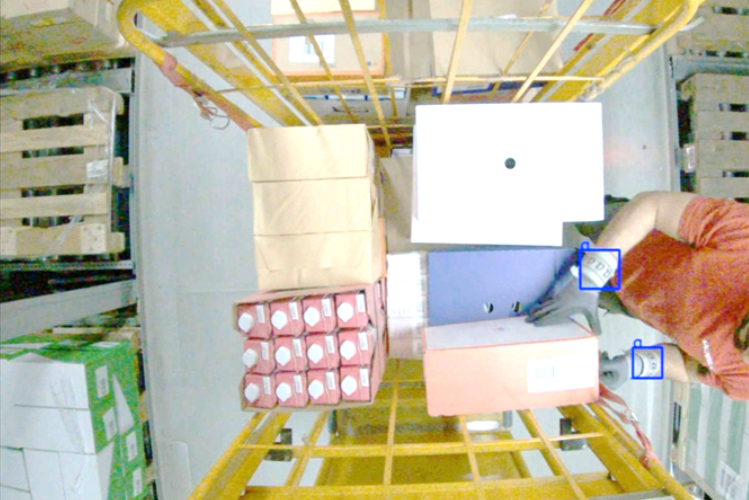
To gain up to 35% in productivity while still having 100% control over picking, you can use pick tracking. Arm movements of pickers are tracked using wristbands. This allows us to detect what is picked and where it is placed on the pick cart. With the additional help of 3D cameras, the volume of the picked items can be determined, so that the number of picked items can also be checked. Optionally, performance bonuses can be determined for the weight picked per picker; otherwise no personal data is stored.
Want a faster identification workplace?
Talk to one of our experts — no commitment.