More pallet positions out of existing halls —
without building a square metre.
Seasonal peaks, returnable flows, high turnover rates: your beverage warehouse has up to 25 % more capacity than you think — and your items are not where they should be. We fix both.
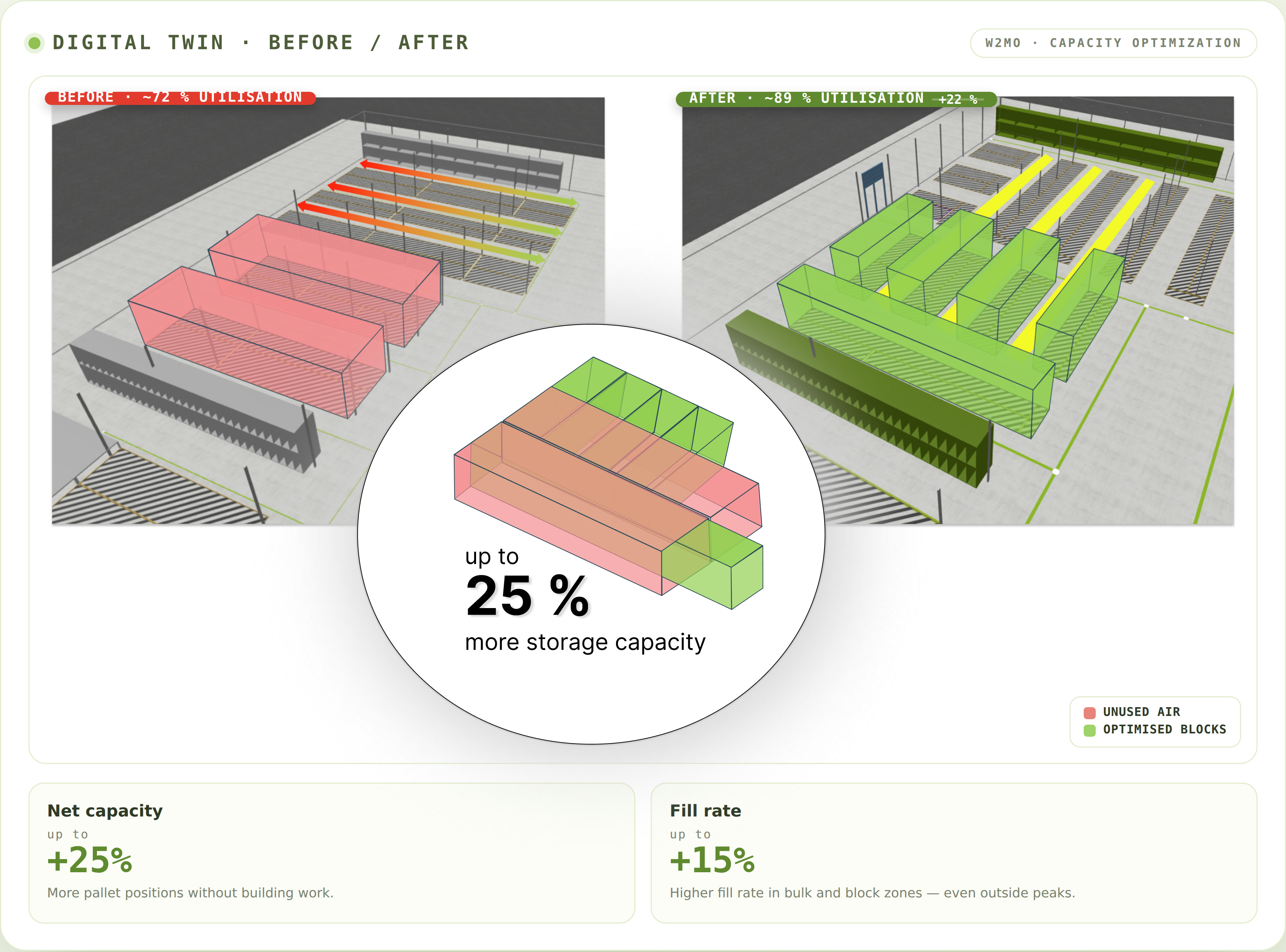
More pallet positions without building work.
Higher fill rate in bulk and block zones — even outside peaks.
More pallets per hour through optimised travel and slotting.
Statements we hear in beverage warehouses, again and again.
Five typical situations from daily operations in the industry — you'll recognise at least one.
Every summer it gets tight
Seasonal peaks, promotional goods, big events: throughput doubles — and the capacity that's enough through winter becomes the bottleneck. External storage and rented space cost real money.
The SKUs aren't where they should be
Fast movers stuck in the back corner, slow movers on the best slots. Forklifts drive unnecessary distances because nobody re-thought slotting after the last assortment change.
The block sizes don't fit anymore
Block depths and zones were set years ago. Products, production batch sizes and order volumes have shifted — but the structure stayed. There's air in every row.
Empties make everything complicated
Returnable flows take up floor space, cross travel paths, block dock doors. Historically grown, rarely cleanly zoned — and every summer a new improvisation.
Every change feels risky — what if it ends up worse?
Restructuring a live beverage warehouse is no small move. You need certainty that the switchover works before you move the first pallet — not a PowerPoint with arrows.
What warehouse and plant managers talk to us about.
- Create more pallet positions — without building extensions or renting external storage
- Handle seasonal peaks without extra shifts or rented space
- Reduce forklift travel and worker walking time
- Integrate returnable flows into the layout in a process-safe way
- Run the numbers properly before investment decisions (high-bay, AGV, new build)
- Validate capacity and processes in simulation before implementation
From Digital Twin to a validated target structure.
Four steps that have proven themselves in many projects. Typical project duration: 8 weeks to 4 months — depending on warehouse size and data availability.
Build the Digital Twin
Layout, zones, master data, stock and movement data are brought together in W2MO as a walkable 3D model.
Calibrate & optimise
Reconcile the model against reality — travel paths, process times, throughput. Then let capacity algorithms compute, under all constraints, a new layout structure.
Slotting & simulation
Zoning by sales velocity and seasonality. Simulate peak scenarios, iterate, compare side by side — all in one tool.
Implement & monitor
Re-slotting lists prioritised by impact. SAP integration brings assignments into EWM/WM. The Digital Twin remains as a monitoring instrument.
The result isn't a recommendation on paper, but a simulation-validated target structure — in a bulk warehouse often already implementable through adjusted floor markings and new WMS entries. No construction work.
Talk to your twin — not to your spreadsheet.
Via MCP servers, the AI model accesses warehouse data and simulation results directly. No more hand-prepared data sets.
A first read in hours — not weeks.
For beverage logistics we provide a specialised W2MO skill that works with your AI model through the MCP server. You hand over a handful of data points — number of pallet positions, assortment structure, current layout, seasonal profile — and the skill returns a first, defensible read on the achievable capacity gain.
That tells you before kick-off whether a deeper project will pay off — typically the additional pallet positions land in the 5–10 % range.
Natural language, not menus
"Show me the 50 items with the longest pick path." "Simulate a switch to AGVs in zone B." Answers in seconds, straight from the twin — no IT ticket.
MCP server as the bridge
The W2MO MCP architecture gives AI models direct access to warehouse data, optimisation algorithms and simulation results — with no interface engineering.
Faster data integration
AI-generated REST interfaces and automatic consistency checks slash setup time. Import, validate and connect data — in minutes instead of days.
Bring your own AI model
Connect any LLM — Claude, ChatGPT, Gemini or your own — via the W2MO MCP server. You pick the model, you control the data. No vendor lock-in.
Ranges we regularly observe.
More net pallet positions in bulk and block-stack areas.
Less travel through optimised slotting.
Higher fill rate in block zones, even outside peaks.
Validated in simulation before the first pallet is moved.
Mid-sized beverage warehouse with 5,000 pallet positions
20 % more capacity equals roughly 1,000 additional pallet positions. At typical storage costs of around €3 per pallet per day, that's a value in the six- to seven-figure range per year — without a single newly built square metre.
The ranges shown are typical project results. The concrete potential depends on the starting state of your warehouse and can be quantified in a few days through an initial analysis.
W2MO modules used in this use case.
Start with one or use the full package.
Digital Twin
A 3D model of your warehouse as the basis for planning and analysis.
Capacity Optimization
Optimal pallet-position and block sizes through 3D packing algorithms.
Advanced Slotting
Product placement by sales velocity, seasonality and zones.
Simulation
Validate the target structure against peak scenarios.
Logivations — numbers you can rely on.
What customers ask us before the project.
Does live operation have to stop for this?
No. Analysis and planning happen in parallel to normal operations inside the Digital Twin. Implementation in bulk areas typically goes through adjusted floor markings and WMS settings — with no shutdown.
How long does such a project usually take?
From first data collection to a validated target structure, depending on warehouse size and data availability, typically 8 weeks to 4 months pass between kick-off and result.
What data do you need from us?
Layout information, product master data with dimensions and stacking factors, stock and movement data. We provide a detailed checklist in the initial conversation.
Does it work for combined warehouses (bulk + racking + automation)?
Yes. W2MO handles bulk, racking and automated warehouses in a single unified model. Mixed configurations benefit especially, because the interfaces between areas become visible.
We already run SAP EWM — does this fit?
Yes. Logivations has worked with SAP and SAP partners for many years and integrates turnkey into SAP. Assignments and structures developed in the project flow directly back into SAP EWM/WM/TM — via certified interfaces or RESTful APIs.
What if we have to build new in the end after all?
Then the model is the best basis for that decision. High-bay, automation, extension — all variants can be computed in the same twin, on the same data. An investment decision then isn't taken from the gut.
Recognise your warehouse in this description?
Three ways to take it further — no commitment.
Talk to an industry expert
30 minutes, tailored to your situation — free and without obligation.
Book a slot →Calculate savings potential
Our online calculator gives an initial range for your warehouse in minutes.
Run ROI check →Download the white paper
"Capacity optimisation in beverage warehouses" — methodology, approach, worked examples.
Get the white paper →