
Every item in the right place —
recalculated every day.
High SKU variety, volatile demand, returns and tight cut-off windows. Advanced Slotting and Dynamic Putaway move your items to where they should be today — not where they were stowed a year ago.
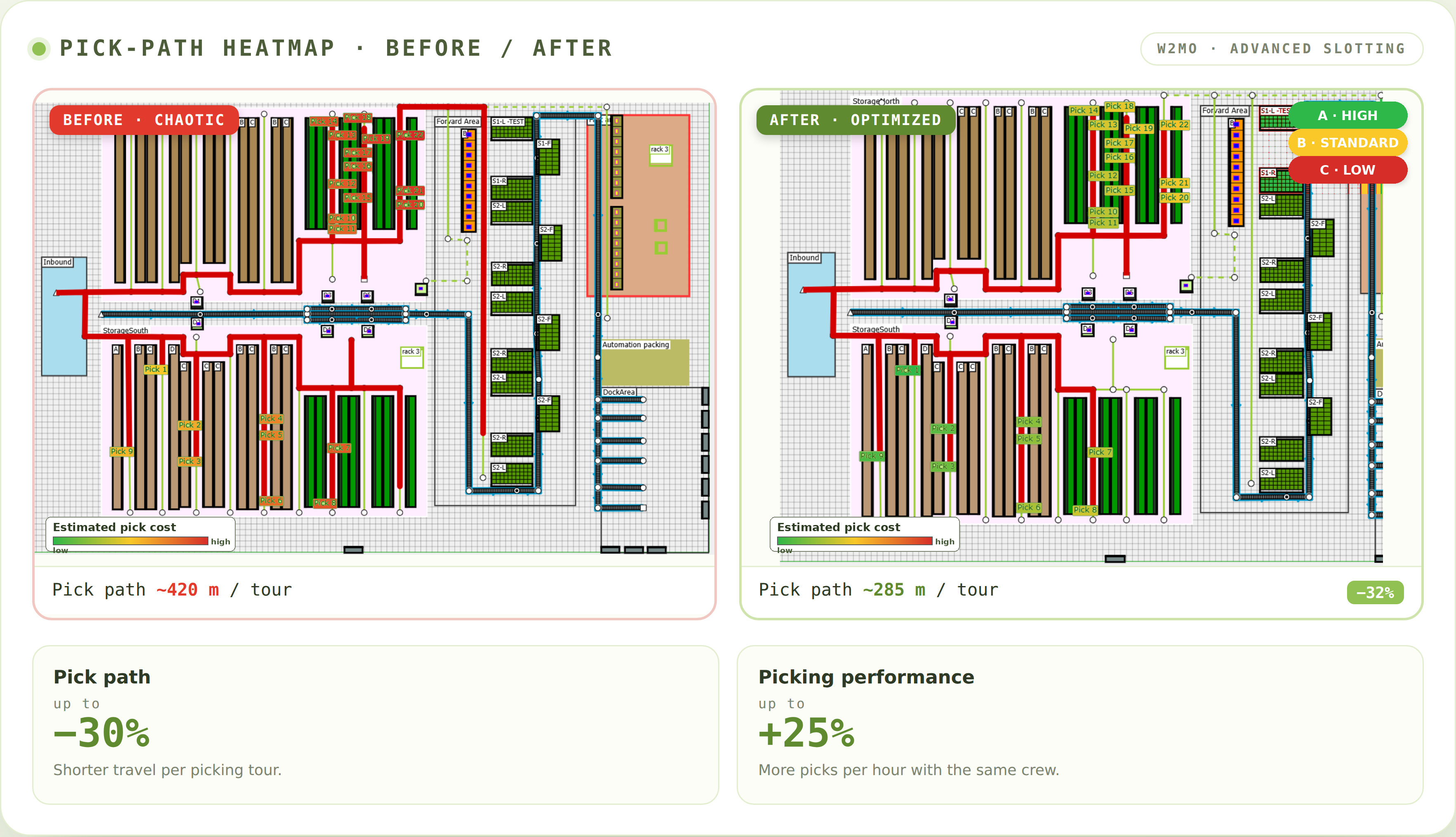
Shorter travel per picking tour.
More picks per hour with the same crew.
Fewer pick errors by separating look-alikes.
Statements we hear again and again.
Five typical situations from daily warehouse operations — you'll recognise at least one.
The pickers are walking half the day
Fast movers are scattered across the warehouse, cross-selling items live in separate aisles. In peak season every unnecessary metre shows — and at 3,000 picks a day it becomes a second shift.
Our assortment turns faster than we can re-slot
New products, seasonal items, promotional goods: today's top-100 are different in three months. Slotting lags behind — and once it's finally re-organised, the assortment has shifted again.
Our cut-off time has become nerve-wracking
Same-day shipping, next-day promises, store replenishment by 6 PM — every delay costs revenue or service level. And a bottleneck at the pack stations stops half the warehouse.
Pick errors cost us returns and trust
Two items that look almost identical sit next to each other. The picker grabs the wrong one, the customer returns it, the work doubles — plus a bad review.
Every re-slotting takes weeks and nobody knows if it'll really be better
Re-slotting means moving items, retraining people, changing habits. Without knowing up front whether the new plan will hold up in peak phases, no one wants to commit.
What warehouse managers talk to us about.
- Build a robust forecast for picking volume per SKU — the basis for every slotting decision
- Shorten pick paths — without hardware investment, just with better slotting
- Balance workload evenly across zones and shifts
- Bring cross-selling and set items physically together
- Cleanly separate look-alike items to reduce pick errors
- Introduce Dynamic Putaway for chaotic storage
- Simulate slotting changes in the Digital Twin before moving the first item
From Digital Twin to continuously optimised slotting.
Five steps that have proven themselves. Typical project duration: 8 weeks to 4 months — after that, slotting stays dynamic in live operation.
Build the Digital Twin
Layout, racking, pick stations, master data and order history become a walkable 3D model in W2MO — including correlation analysis.
Build the forecast
Identify and connect data sources, choose appropriate forecasting methods, backtest against historical data — and tune parameters until the forecast holds up.
Optimise slotting
Algorithms compute the best assignment: ABC zoning, set assignments, look-alike separation, workload balancing.
Simulate & plan changeover
Simulate peak scenarios: Black Friday, Christmas, return waves. W2MO produces prioritised re-slotting lists.
WMS integration & live operation
Slotting results flow directly into the WMS — as transfer transport orders for fixed slots or as Dynamic Putaway recommendations for chaotic storage. SAP EWM, WM/LES or REST API.
The result isn't a one-off optimised warehouse, but a continuously self-adjusting slotting. Chaotic storage stays chaotic — but every item lands where current order patterns say it belongs.
Talk to your twin — not to your PowerPoint.
Via MCP servers, Claude, Gemini or ChatGPT access your warehouse data directly — no more hand-prepared data sets.
Natural language, not menus
"Show me the 50 items with the longest pick path." "Simulate the slotting for the Black Friday assortment." Straight from the chat.
MCP server as the bridge
The W2MO MCP architecture gives AI models direct access to warehouse data, algorithms and simulation results — with no interface engineering.
Faster data integration
AI-generated REST interfaces and automatic consistency checks slash setup time. Minutes instead of days. The LLMs surface every available forecasting model, ready to combine and integrate.
Bring your own AI model
Connect any LLM — Claude, ChatGPT, Gemini or your own — via the W2MO MCP server. You pick the model, you control the data.
What we typically measure in the field.
Shorter pick paths through optimised item placement.
More picks per hour with the same headcount.
Fewer pick errors by separating look-alikes.
Validated in simulation before the first item is moved.
E-commerce warehouse with 3,000 picks per day
A 25 % shorter pick path, with typical 60–80 seconds of walking time per pick, equals roughly 2 to 3 person-hours per day freed up for throughput or relief. Over a year: half to one full-time role — or, in peak weeks, the extra capacity you would otherwise hire in as temps.
The ranges shown are typical project results. The concrete potential depends on the starting state of your slotting and on order structure — and can be quantified in a few days through an initial analysis.
W2MO modules used in this use case.
Start with one or use the full package.
Digital Twin
A 3D model of your warehouse as the basis for planning and analysis.
MCP server
Forecasting models integrated directly with the W2MO Digital Twin.
Advanced Slotting
Optimal item placement with Dynamic Putaway and reorganisation.
Simulation
Validate peak scenarios and changeover plans before execution.
Transport orders & sequence
Optimal pick sequence and tour-building for batch and wave picking.
Logivations — numbers you can rely on.
What customers ask us before the project.
Does slotting work with chaotic storage too?
Yes — especially then. For fixed storage locations we optimise the item assignment. For chaotic warehouses Dynamic Putaway takes over: at every goods receipt the algorithm computes the best free location based on current and expected pick volumes. Slotting then emerges continuously in live operation.
How do we handle seasonal assortment changes?
The Digital Twin works on historical and forecasted order data. Before a season switch we simulate the new slotting in advance and produce changeover lists that only contain the genuinely impactful moves.
Does live operation have to stop for this?
No. Analysis and planning happen in parallel to normal operations, inside the Digital Twin. Re-slotting moves are prioritised by impact — often 10–20 % of the possible moves deliver 80 % of the effect. Dynamic Putaway runs entirely in live operation, with no transition phase.
How long does such a project usually take?
From first data collection to a productive slotting optimisation, 8 weeks to 4 months is realistic, depending on warehouse size and data availability. Dynamic Putaway can then run continuously.
We're already on SAP EWM / another WMS — does this fit?
Yes. Logivations is a long-standing SAP Application Development Partner. Slotting results and transfer transport orders flow back directly into SAP EWM/WM. Other WMS systems we integrate via the W2MO SAP / database connector or RESTful APIs.
Does it work for mixed warehouses (manual + shuttle / mini-load)?
Yes. W2MO decides, per item, whether it belongs in the automated or the manual area — taking volume, weight, pick frequency and system utilisation into account.
Recognise your warehouse in this description?
Three ways to take it further — no commitment.
Talk to an industry expert
30 minutes, tailored to your situation — free and without obligation.
Book a slot →Calculate savings potential
Our online calculator gives an initial range for your warehouse in minutes.
Run ROI check →Download the white paper
"Advanced Slotting in E-Commerce" — methodology, approach, worked examples.
Get the white paper →