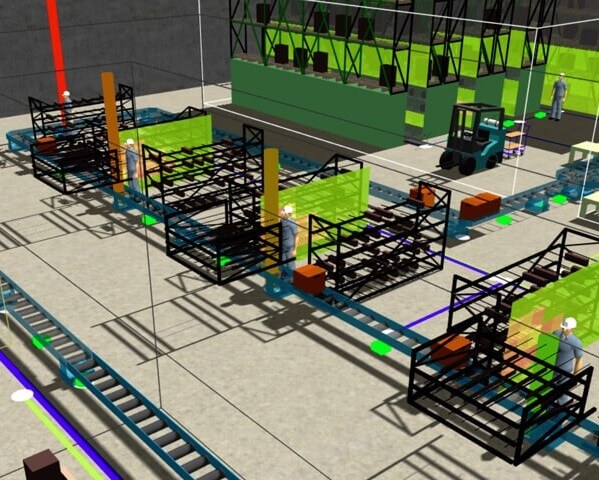
Simulation with the Digital Twin.
Use the Digital Twin to run detailed simulations of different scenarios to understand how best to set up your process.
-
Detailed simulation / analysis
Identification of potential improvements, support for strategic decisions.
-
Practical evaluation
Of automation and mechanization possibilities.
-
Consistent database
Allows efficient data collection, verification, consolidation and handling in one tool due to its modern architecture.
-
Integrated process analysis
With direct transfer of evaluated parameters to the Digital Twin.
-
Improvement of results and labor savings
In tendering and calculation of logistics services.
-
Extensive statistics
For an in-depth analysis of input data and results, visualization of data and results in 2D and 3D, sustainable setup by extrapolation and scenario calculation.
Digital Twin for Warehouses and Distribution Centers.
Identification of potential improvements, support for strategic decisions.
- Combination of a 3D model with live data (such as tracking) and data from other systems — orders, throughput, or inventory of individual products
- Simulation of material flow, staff deployment, and use of forklift trucks
- Identification and elimination of unproductive processes
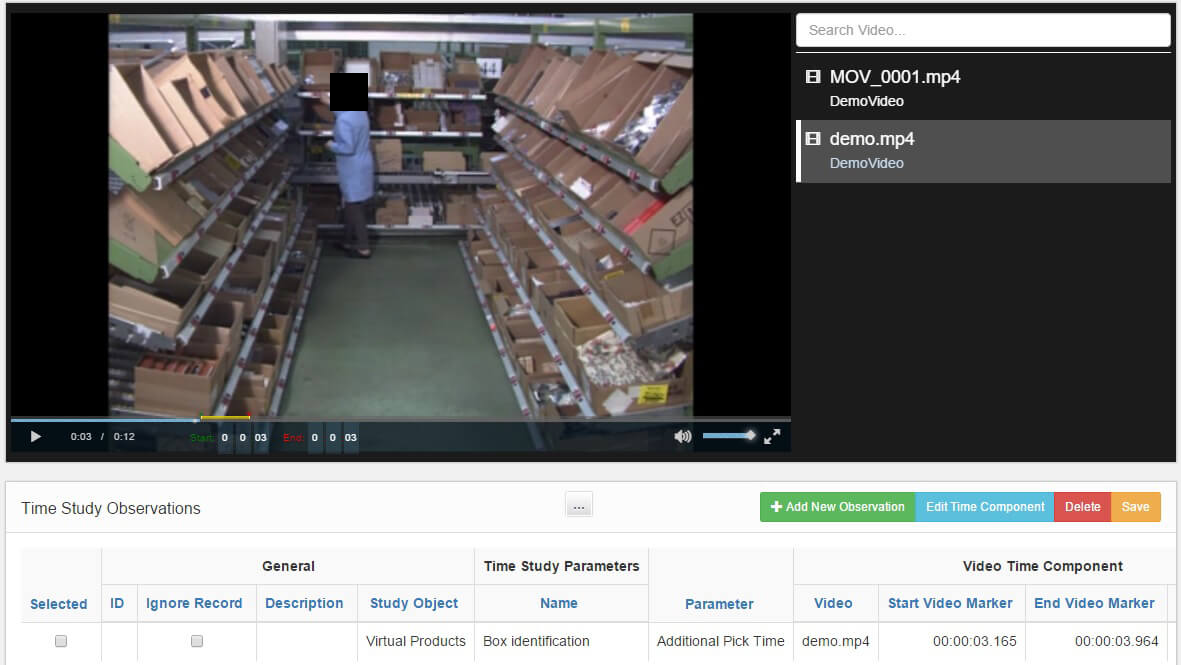
- Integration of video process studies
- Testing and evaluation of the impact of layout changes, new equipment, and new processes
- Dynamic optimization of product assignment, staff, and material deployment
W2MO provides the ability to create a digital twin for the design, optimization, and operation of warehouses and distribution centers. A 3D model is integrated with business data from the warehouse management or ERP system, including master, inventory, and consumption data, and can be enhanced with live data, such as tracking data. Video process studies with a direct transfer of the required parameters into the Digital Twin further increase the accuracy. This provides the basis for a comprehensive analysis of planning alternatives and the identification or elimination of unproductive processes and procedures. With a digital twin, the distinction between planning, continuous improvement, and dynamic optimization of operational processes becomes blurred.
Standard Times & Video Process Studies.
Of automation and mechanization possibilities.
- Easy recording, analysis, documentation, and optimization of all kinds of processes in production and logistics
- Detailed calculation of the workload, split into separate elements, processes, or granular activities
- Recording and analyzing both speeds and times
- Privacy protection through automated head blurring
- Direct transfer of evaluated parameters to the Digital Twin for future computations
- Performance rating of employees: setting target times, e.g. for a complete picking process including packing and labeling, and comparing with as-is times
W2MO offers a comprehensive solution for process studies, providing users with an easy and simple way to record, analyze, and document times and speeds in all logistical processes. Our unique combination of video recording and a digital twin allows users to evaluate not only times but also speeds, enabling us to calculate realistic times based on the chosen route and start and end points. No average times are used. Based on this, processes can be optimized and extremely time-consuming steps can be eliminated. Privacy protection is also considered. With integrated head blurring people can be anonymized in video recordings. W2MO offers the possibility to use the necessary parameters to set targets for the employees; e.g., for a single pick including packing and labeling.
Warehouse Capacity Optimization.
In tendering and calculation of logistics services.
- Strategic calculation of optimal bulk area and rack sizes
- Optimization based on multiple stock snapshots and consideration of storage strategies and many constraints
- Flexible definition of constraints and fast analysis of the effects
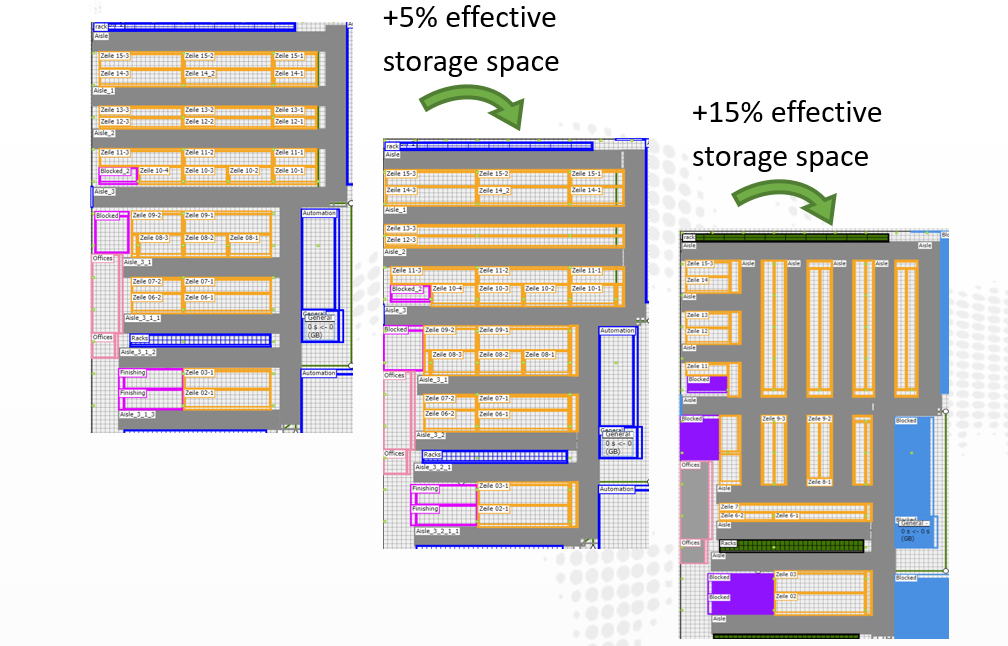
- Increase of effective storage utilization and fill level of used areas and rack capacity by up to 20%
- Enhancement of operational efficiency through improved storage management
The warehouse capacity optimization process starts with the calculation of optimal storage area sizes based on product characteristics, inventory data, demand behavior, and additional constraints. In the second step, these optimally dimensioned storage areas are placed efficiently within the warehouse to maximize effective capacity. In addition to this approach — which focuses on individual slot placement, e.g. for pallet storage — W2MO's innovative algorithms can also be used to restructure warehouses with dynamically used bulk storage areas, significantly increasing the fill level (e.g. in warehouses with a heterogeneous product portfolio).
Data Collection and Validation.
Allows efficient data collection, verification, consolidation and handling in one tool due to its modern architecture.
- Use of standard data templates for import and export
- Integration with SAP or other ERP / warehouse management systems
- Automatic verification of data consistency and correction of data errors
- Creation of a unified database for simulation and optimization projects
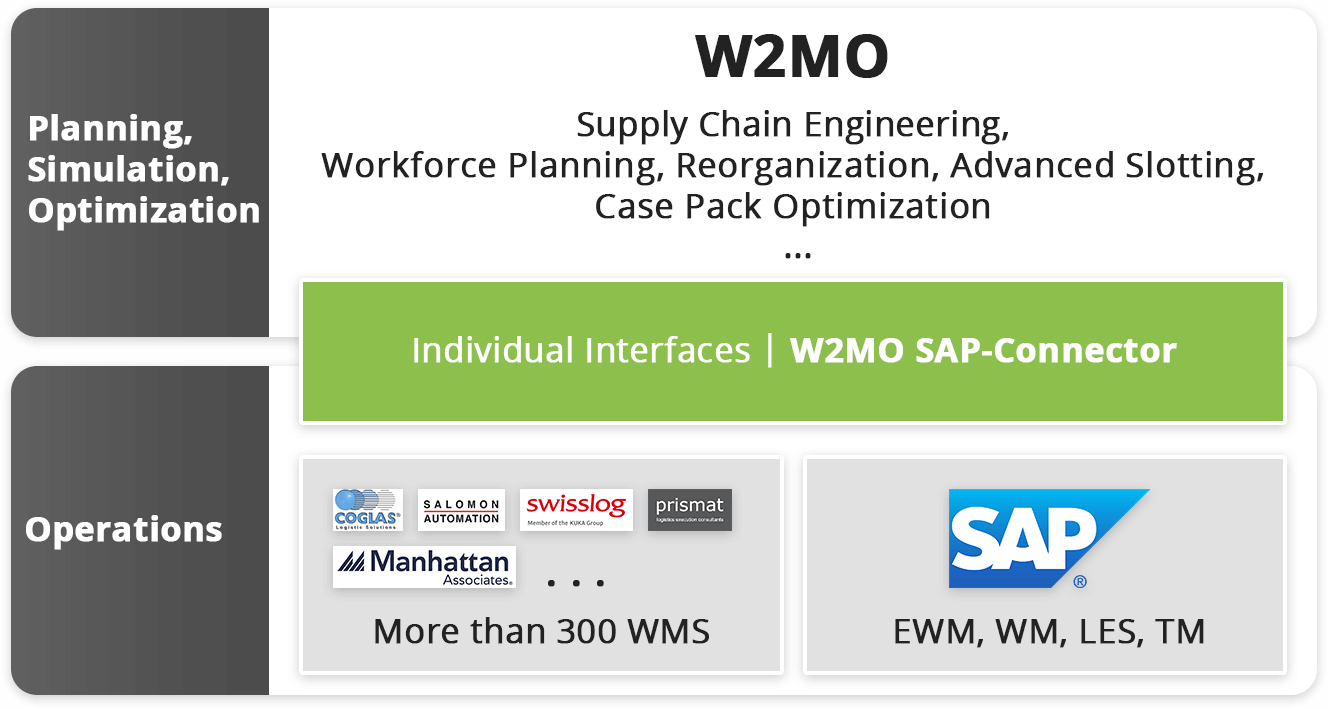
The logistics sector has a higher level of data information than other business areas, including product master data, movement data, customer orders, and inventory. This makes it crucial for logistics companies to have a structured approach to big data — to optimize layout and processes, identify long-term trends, and evaluate alternatives. W2MO offers a variety of configurable interfaces for each use case. Data for planning tasks can be prepared in Excel and uploaded as a .csv file. Alternatively, data can be automatically transferred from WMS, ERP, or TM systems on a daily basis. The SAP connector provides a standard interface to all SAP systems. W2MO provides algorithmic support to validate the data used and allows automatic correction of data errors. Model errors, data gaps and inconsistencies are avoided and repaired immediately. At the same time W2MO provides a consistent database for simulation and optimization projects.
Data Generation and Extrapolation.
With direct transfer of evaluated parameters to the Digital Twin.
- Generation of product and order data with the help of statistical key figures
- Creation of future scenarios based on historical data using artificial intelligence
- Maintenance or targeted modification of order structure for planning scenarios
- Easy closing of data gaps
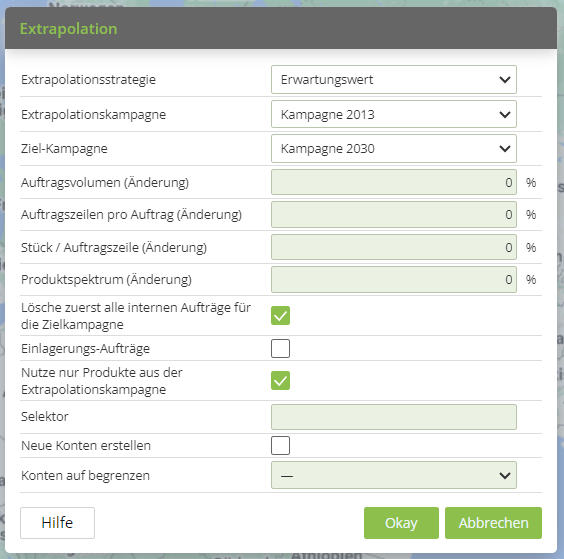
Logistics planning and optimization are inherently future-oriented. While exact data on product and order structures is only available from the past, W2MO offers the ability to create product and order data using statistical distributions. Furthermore, a valid simulation model can be created with a minimal amount of data. Sophisticated extrapolation algorithms assist in generating goal-oriented, foresighted order structures. The result is based on historical data and accurately reflects the expected business development. This methodology is employed to address any data gaps that may exist.
Data Analysis.
For an in-depth analysis of input data and results, visualization in 2D and 3D, sustainable setup by extrapolation and scenario calculation.
- Wide range of analysis and evaluation possibilities
- Graphical representation in 2D and 3D
- Heatmaps for data visualization
- Possibility to export the results for further processing
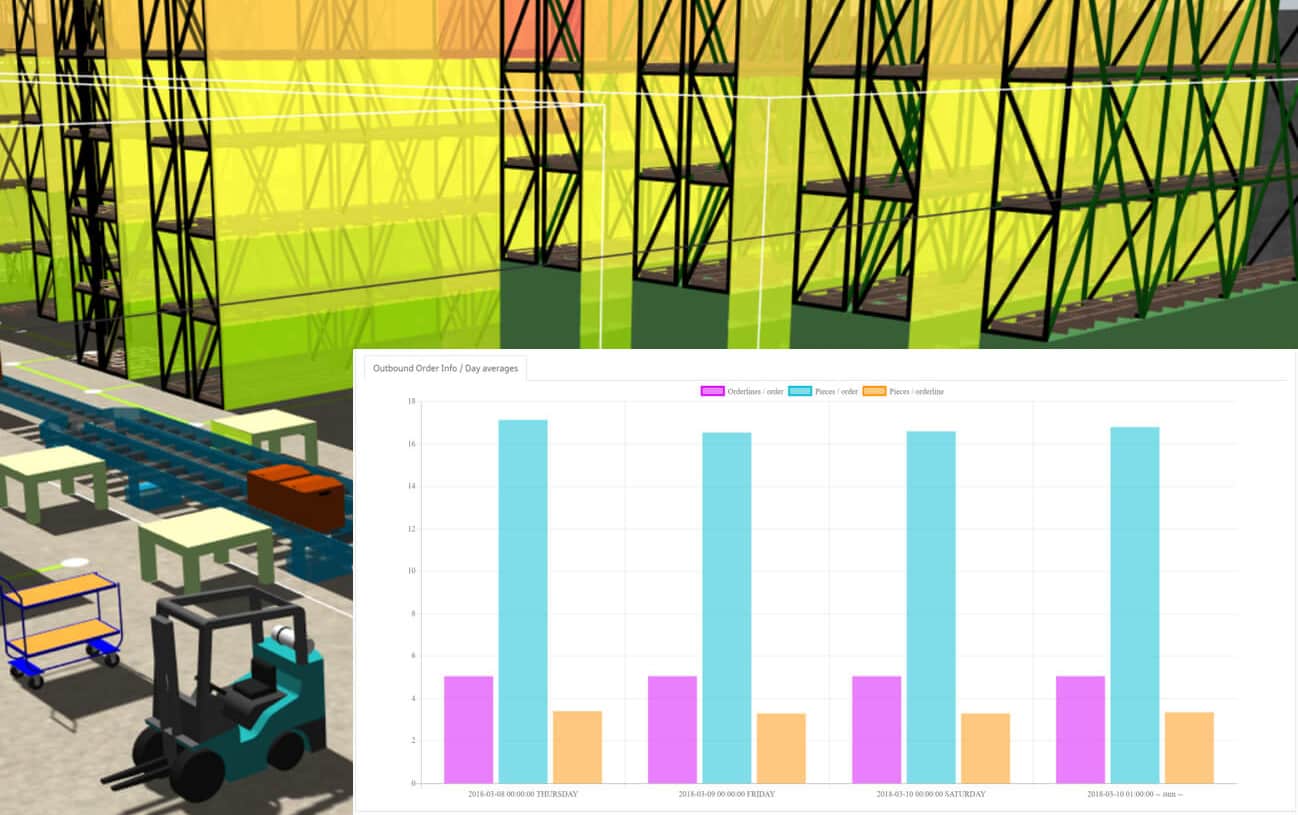
W2MO offers a range of analytical and evaluative tools for the database and its outcomes. The 2D and 3D layout information enables the creation of heat maps for access times, picking amounts, and labor costs. Such visualizations frequently identify potential for optimization and transparently show inefficiencies in current processes.
Scenario Comparison.
Evaluate growth, market entry and portfolio scenarios on real costs and capacity requirements — and compare them side by side.
- Scenario manager for campaign-dependent data management
- Easy comparison of different scenarios
- Evaluation of various growth options
- Comparative analysis of results in detailed reports
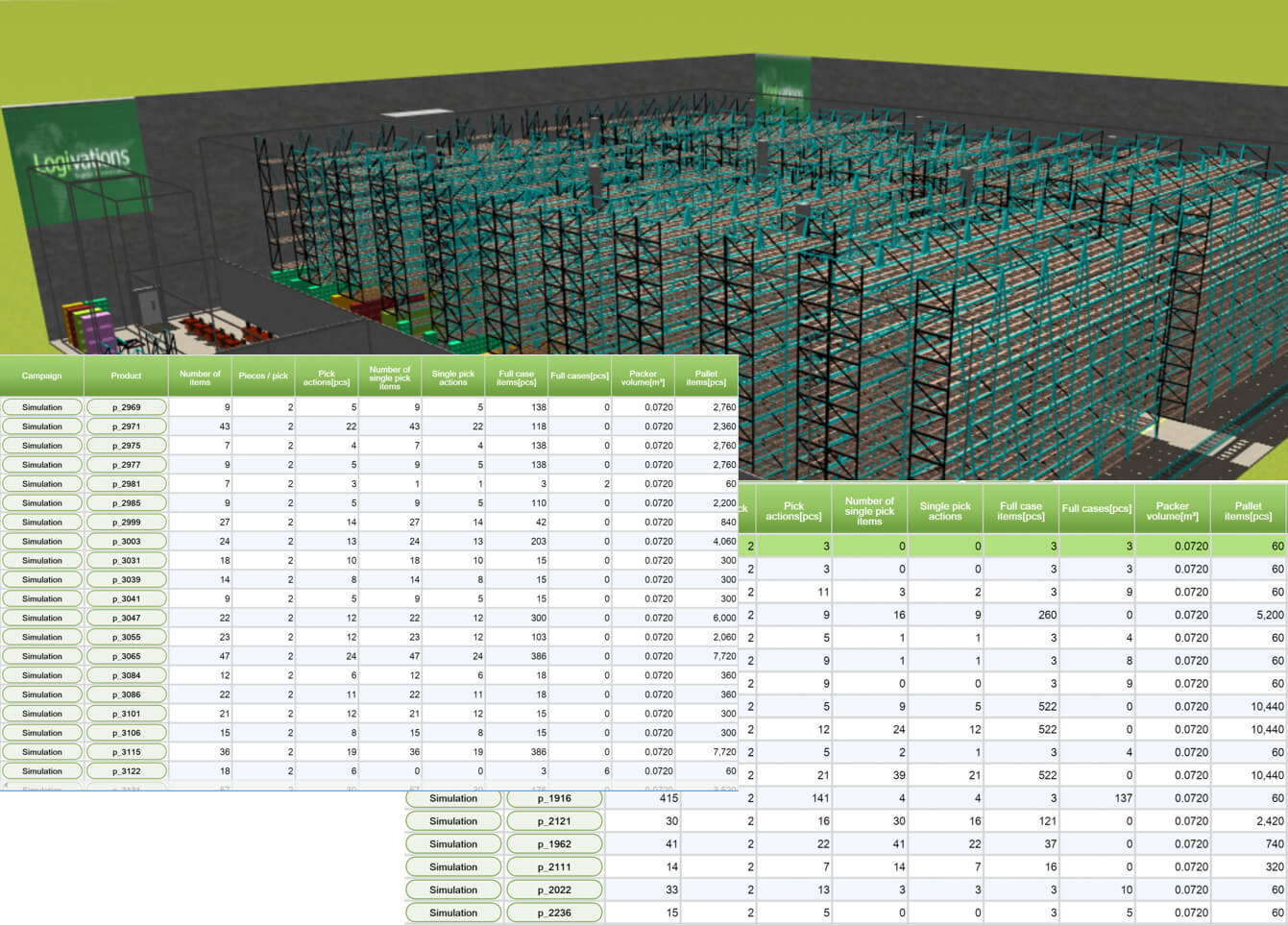
W2MO offers a range of features that enable the creation of realistic and structured databases for a variety of scenarios, including growth scenarios, market entry, segmentation, and developments in the product portfolio. W2MO's simulation functionality allows users to evaluate planning scenarios based on real costs and capacity requirements. Additionally, users can easily model and evaluate different layout scenarios, storage techniques, picking strategies, and warehouse assignment strategies. Scenario evaluation based on simulation allows users to compare the resulting logistics parameters and performance indicators. In addition to static parameters, the analysis also evaluates dynamic effects such as bottlenecks and peak loads.
Want to simulate your warehouse?
Talk to one of our experts — no commitment.