Design and Planning with the Digital Twin.
Perform a holistic planning process while creating a Digital Twin of your warehouse.
Six properties that make W2MO different.
One tool covering the entire logistics planning process — from location search to operational use.
Holistic planning process
From location search to operational use — all in one tool.
Detailed simulation & analysis
Identification of potential improvements, support for strategic decisions.
Consistent database
Efficient data collection, verification, consolidation and handling in one tool thanks to a modern architecture.
Automatic layout generation
A quick benchmark for space requirements and labor costs.
Integrated process analysis
Direct transfer of required parameters into a simulation model.
Extensive statistics
In-depth analysis of input data and results, 2D and 3D visualisation, extrapolation and scenario calculation.
Planning Process in the Digital Twin.
A 3D model integrated with business data — covering everything from rough space requirements to detailed process planning.
- Integration of all planning steps in one tool
- Automatic creation of a 3D model
- Calculation of space and FTE requirements and needed equipment
- Bottleneck checks
- Testing and evaluation of the impact of layout changes, automation equipment and new processes
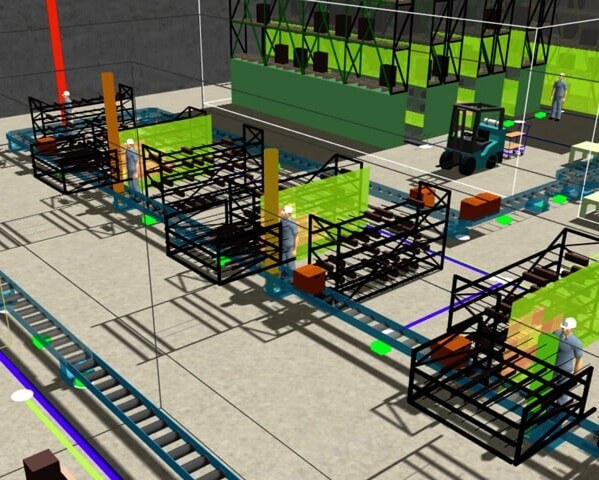
W2MO provides the ability to create a digital twin for the design and planning of warehouses and distribution centers. A 3D model is integrated with business data from the warehouse management or ERP system, including master, inventory, and consumption data. All steps of the planning process can be represented within the digital twin — from initial rough space requirements to detailed process planning and FTE requirements.
Simulation capabilities can be used to compare different layout alternatives to determine the best process setup for your operation. This is accompanied by bottleneck checks and detailed reports and exports for communication with other parties involved in the planning process.
Design by Efficiency.
Calculate future workload with high accuracy based on standard times — and compare the cost and benefit of every layout or process change.
- Consistent evaluation and optimization of processes and structures during restructuring or planning of a new location
- Holistic modeling of warehouse and production logistics
- Determining decisions and investments with the help of scenario comparisons
- Collecting all data and information in one tool — without media discontinuity
The future workload in logistics is calculated with high accuracy during the W2MO layout planning process, based on standard times. This allows for the immediate evaluation and comparison of the costs and benefits associated with each layout or process change. The full range of manual to fully automated systems in warehouse and production logistics can be considered.
The workload for each step is evaluated chronologically, from inbound through standby zones or supermarkets to further handling of picked or manufactured products. A comprehensive set of intelligent algorithms is available for the design of logistics structures.
The use of automation technology can be evaluated in detail, including comparisons with simple methods of storage space allocation and tour building. For example, the impact of goods-to-man systems versus intelligent algorithms on employee walking effort can be evaluated.
Automatic Layout Generation (Layout Design Optimizer).
Automated, optimised warehouse layouts in just a few clicks — a complete 3D simulation model in one go.
- Digital Twin layout creation with just a few clicks
- Benchmarking ideal location capacity and required warehouse space
- Different levels of detail depending on the data basis
- Calculation of costs for equipment, staff and inventory
- Result: a complete simulation model for further studies
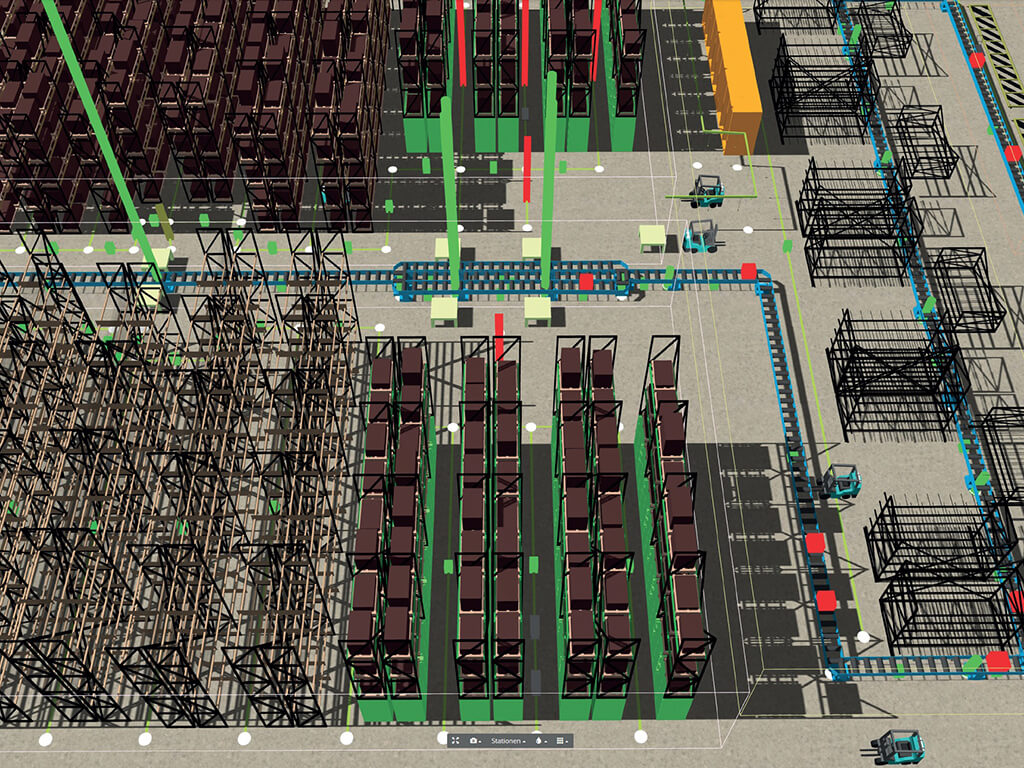
The Layout Design Optimizer (LDO) automates the creation of optimized warehouse layouts with just a few clicks. Its goal is to automate, optimize, and accelerate the layout design process.
Depending on the data availability, the LDO can process very detailed product and order data or alternatively calculate it based on a few statistical parameters. The result is a complete 3D simulation model that includes the space requirements, the appropriate rack structure, and the necessary equipment.
In addition to the expected labor costs, a bill of materials for the required inventory can be derived. This quick and easy model provides an initial benchmark and forms the basis for further detailed planning.
Tendering and Calculation of Logistics Services.
Digital support for tendering on both sides of the negotiation table — replacing traditional spreadsheets.
- Easy and extensive preparation of data and quantity structures
- Digital process documentation and description
- Transparent calculation basis for all products and processes
- Structured evaluation of growth and risks
- Understandable solution visualization for an optimal offer presentation
W2MO provides digital support for the tendering of logistics services on both sides of the negotiation table. Using time components, providers can quantify logistics costs more accurately and reliably. The customer can assess the impact of various business developments through data extrapolation and scenario management.
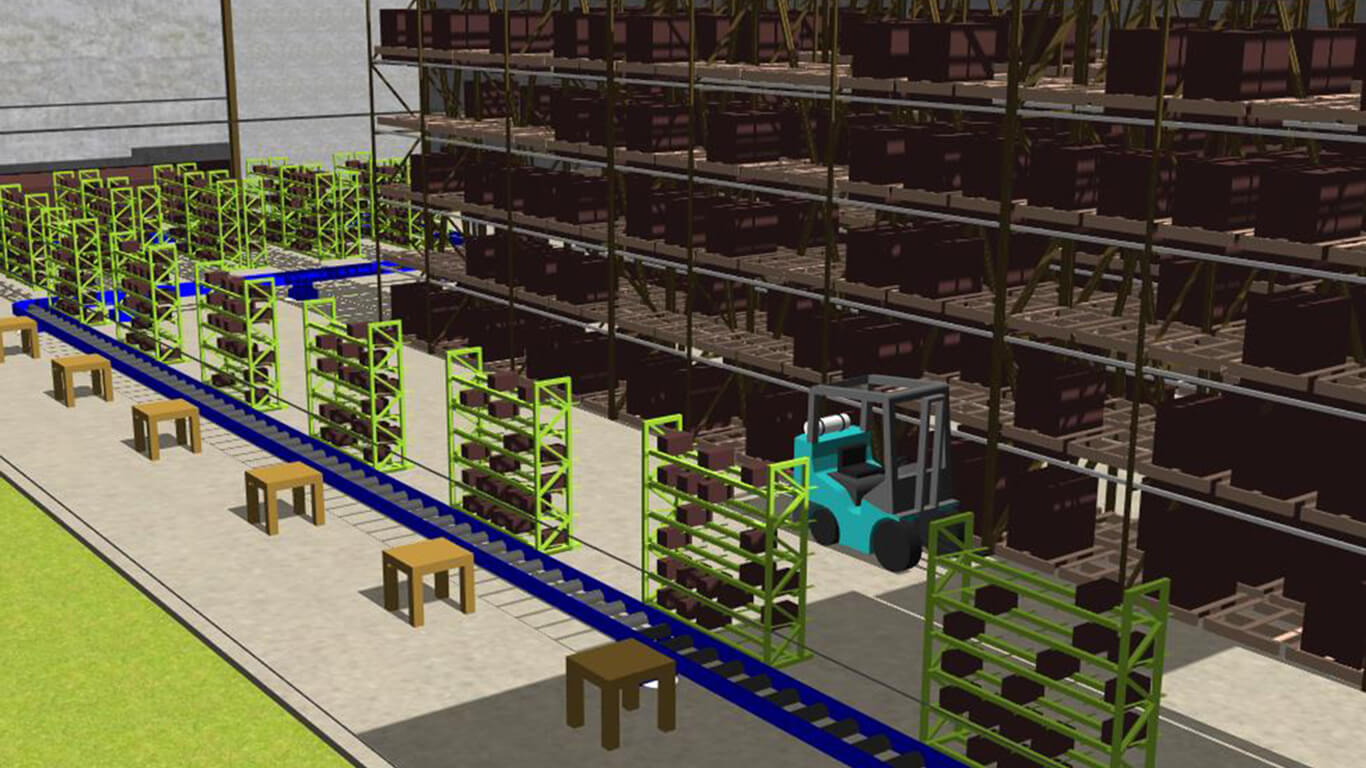
Unlike traditional calculation tools and Excel spreadsheets, these W2MO options can be quickly created and evaluated. Bidders can efficiently calculate the planning options, graph the results, and present them in charts and easy-to-understand 3D models.
Once an operation is up and running, created models can be reused for operational optimization. Alternatively, they can be transferred for use in new projects.
Data Generation and Extrapolation.
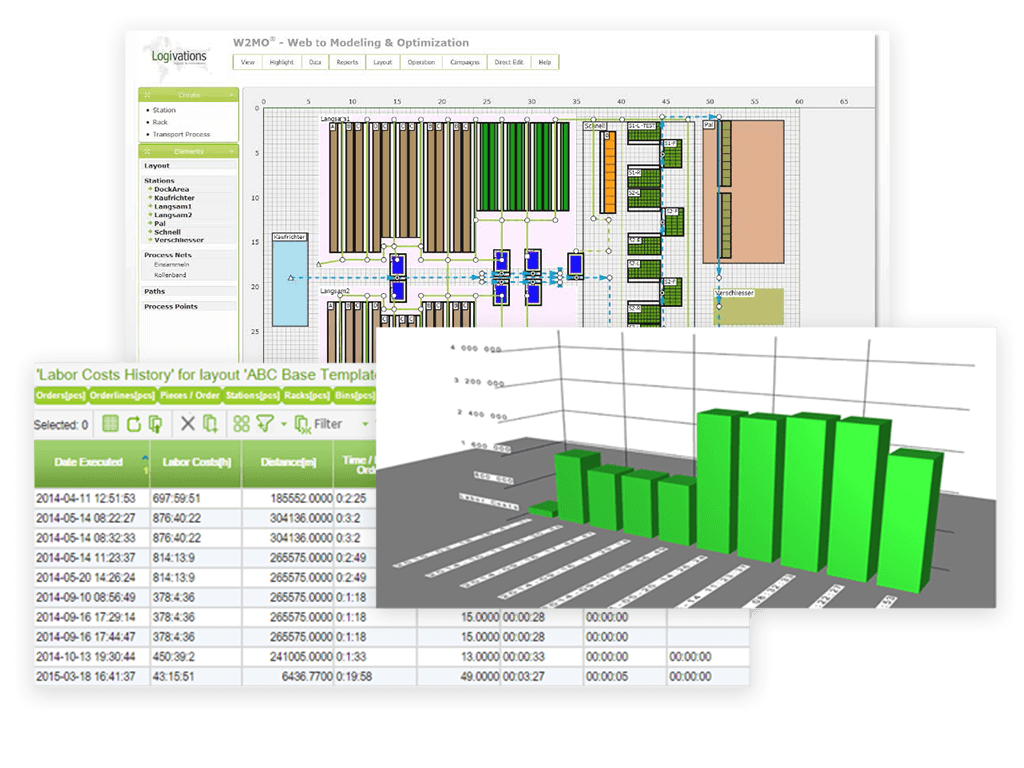
Forward-looking planning even when historical data is incomplete — order structures generated from statistical distributions.
- Generation of product and order data with statistical key figures
- Creation of future scenarios based on historical data
- Maintenance or targeted modification of order structures for planning scenarios
- Easy closing of data gaps
Logistics planning and optimization is inherently future-oriented. While accurate data on product and order structures is only available from the past, W2MO provides the ability to create product and order data using statistical distributions.
Furthermore, a valid simulation model can be created with a minimal amount of data. Sophisticated extrapolation algorithms support the generation of targeted, forward-looking order structures. The result is based on historical data and accurately reflects the expected business development. This methodology is used to fill any data gaps that may exist.
Data Analysis.
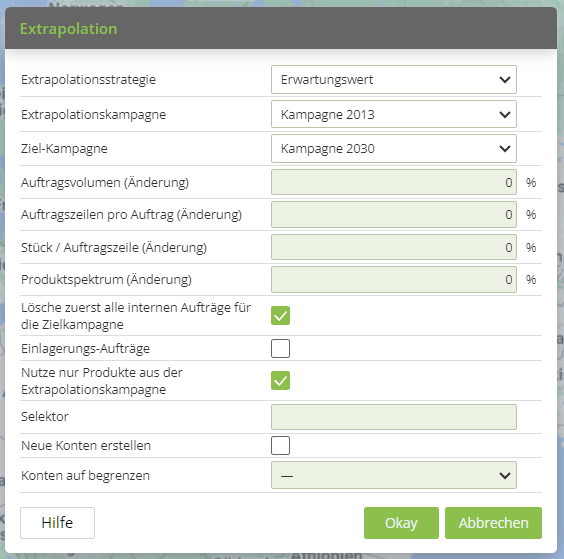
Heat maps for access times, picking amounts and labor costs — making inefficiencies visible at a glance.
- Wide range of analysis and evaluation possibilities
- Graphical representation in 2D and 3D
- Heat maps for data visualization
- Export of results for further processing
W2MO offers a range of analytical and evaluative tools for the database and its outcomes. The 2D and 3D layout information enables the creation of heat maps for access times, picking amounts, and labor costs.
Such visualizations frequently identify potential for optimization and transparently show inefficiencies in current processes.
Ready to plan with a Digital Twin?
Let's take it further — no commitment.